July: -3.3% While Nifty 500 Gained 1.8% — The First Red Month
The first red month of FY27 has arrived, and it was not a market-wide excuse.
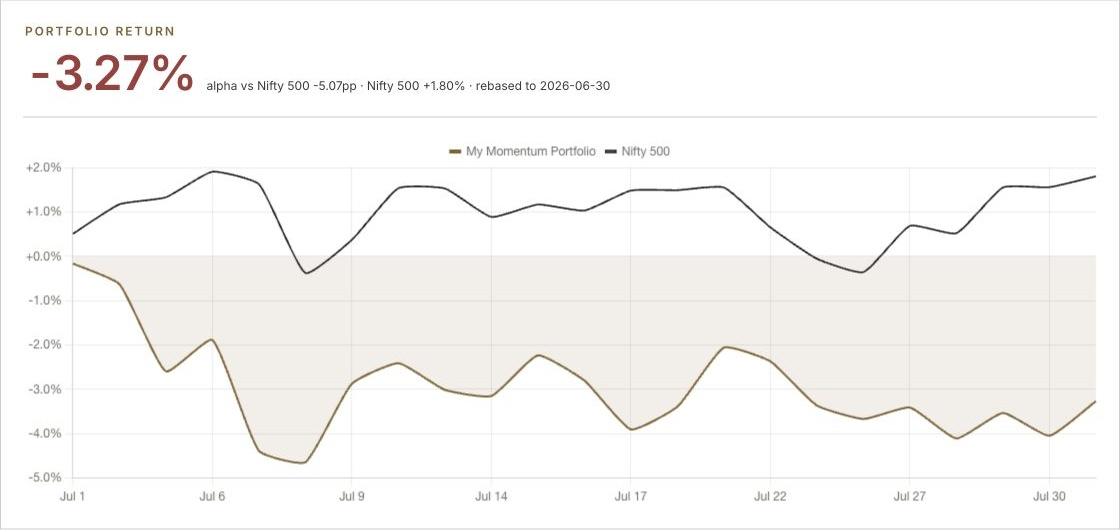
My momentum portfolio closed July at -3.27% while Nifty 500 gained +1.80%. That is -5.07 percentage points of alpha for the month — the first time this financial year that the portfolio both lost money and finished behind the benchmark.
April, May, and June made the system look progressively less exceptional: +11.5, +5.8, then +1.7 points of monthly alpha. July completed that sequence by taking the number below zero. Publishing the red months with the same detail as the green ones is the point of this series.
How July Played Out
| Metric | Value |
|---|---|
| Month return | -3.27% |
| Nifty 500 return | +1.80% |
| Alpha vs Nifty 500 | -5.07 pp |
| Trading days | 23 |
| Up days / Down days | 9 / 14 |
| Best day | Jul 9 (+1.86%) |
| Worst day | Jul 7 (-2.55%) |
| Max drawdown | -4.64% |
Fourteen down days against nine up days. The problem was not one catastrophic session; it was persistent weakness. July's worst day was -2.55%, uncomfortable but ordinary for a concentrated momentum basket. What made the month damaging was that the recoveries never held.
The Shape of the Month
July had three acts, all below the starting line:
- The early break. The portfolio was down from the first session and reached its monthly low near -4.6% by July 8. Nifty 500 was still positive over the same stretch. This was portfolio-specific weakness, not a broad-market drawdown.
- A partial recovery that stopped short. The July 9 bounce was the best day of the month at +1.86%. The book recovered to roughly -2% twice, but never crossed into positive territory.
- Another fade into month-end. The final week pushed the portfolio back below -4% before a last-day recovery lifted the close to -3.27%. Better than the low, but still a decisive miss against a benchmark finishing at +1.80%.
The important distinction is between volatility and failure. A volatile month can still finish with the strategy doing its job. July did not. The system held the wrong collection of names for the market that actually showed up.
The Benchmark Gap Reversed
The previous three updates were about how quickly the portfolio built a lead. July is about how quickly part of that lead can disappear.
At the end of June, FY27 alpha stood at +21.03 points. One month later it is +14.67 points. Nothing dramatic happened to the index; the Nifty 500 simply advanced while the portfolio declined. That combination closed more than six points of the gap in 23 sessions.
This is the less photogenic side of momentum. A concentrated basket can keep falling even when the broad market is fine because leadership has rotated away from the names the system owns. The rules are intentionally slow to respond: they wait for the trend condition to break instead of treating every weak week as a reason to trade.
That delay creates pain in months like July. It is also what prevents the portfolio from being whipsawed by every temporary dip. The trade-off is structural, not a bug that can be removed after seeing the outcome.
Holdings
The July month-end check flagged one rules-based exit. It will be executed at the next market open. The rest of the book remains unchanged.
That leaves 14 holdings and one slot in cash, roughly 7% of the portfolio, until the next quarterly entry cycle. There is no discretionary replacement and no attempt to immediately earn the money back. When a monthly exit opens a slot, cash is the position until the system is allowed to select a new name.
FY27 So Far
The red month changes the shape of the year, but not the fact that the portfolio remains ahead.
| FY27 (Apr-Jul) | Portfolio | Nifty 500 | Alpha |
|---|---|---|---|
| Total return | +28.71% | +14.04% | +14.67 pp |
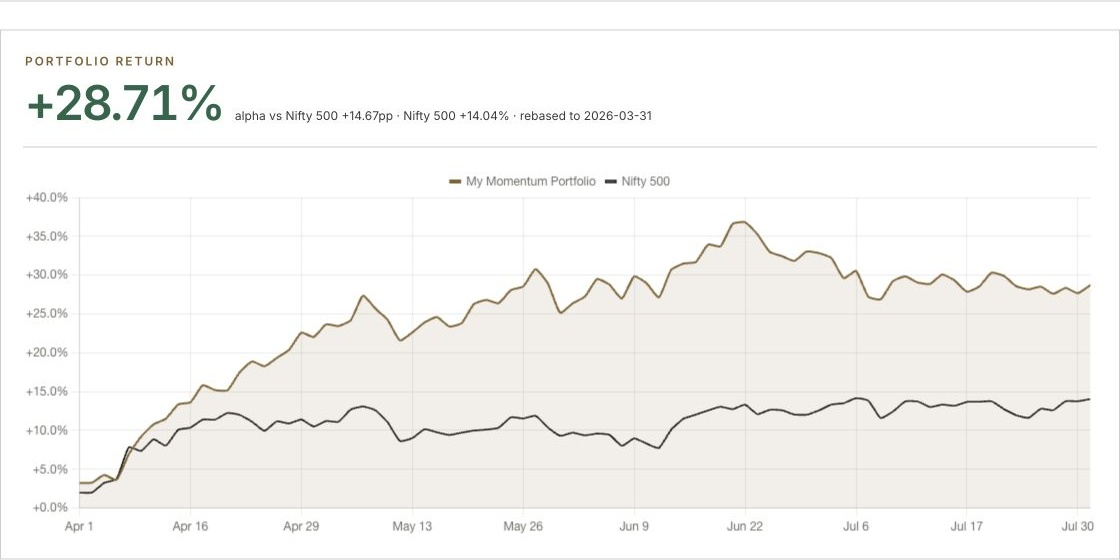
The right reading is not “still up 29%, so July does not matter.” July matters precisely because a strategy has to survive the months when its current holdings stop working. The FY number is the buffer accumulated during the good regime; the next test is how much of that buffer the exit rules protect if weakness continues.
What Did Not Work
- The portfolio never turned positive. There was no point during July when the month was in profit. Every recovery remained a recovery from a loss.
- Selection overwhelmed the market backdrop. Nifty 500 gained 1.80%, so broad beta cannot explain the decline. The basket itself underperformed.
- The bounces lacked follow-through. Two recoveries toward -2% were followed by fresh weakness. Momentum inside the portfolio was not merely cooling; it had become inconsistent.
- The alpha cushion shrank quickly. A 21-point FY lead became a 14.7-point lead in one month. Large cushions feel permanent until they are not.
What's Next
August begins with 14 holdings, one cash slot, and the same rules.
There is no new forecast to make. If the remaining trends hold, the system stays invested and waits for leadership to reassert itself. If more names break, exposure falls further and cash rises. The next quarterly refresh is the only point at which empty slots can be filled.
April showed what the strategy looks like when everything works. July showed what it looks like when the benchmark rises and the portfolio does not. Both belong in the record.
Personal trading account. Not investment advice. Past performance is not indicative of future results. Investments in securities are subject to market risks. I do not currently hold a SEBI Research Analyst registration; this is a personal portfolio update, not a research recommendation.